
Bin blenders / tumbler mixers
Drum mixer
IBC Bin blender
Bin tumbler
Follow us on Twitter

Question, remark? Contact us at admin@powderprocess.net
| Section summary |
|---|
| 1. Definition of a bin blender |
| 2. Mixing principle |
| 3. Process Sizing & Design Calculator |
| 4. Mixing operating parameters |
| 5. Detailed specifications |
| 6. Common problems with bin blenders |
1. Definition of a bin blender
What is a bin / IBC blender?
Bin blenders are mixers for which the mixing driving force is achieved by rotating the whole bin, with mixing by free-fall within the rotating shell and without agitators (with some exceptions). Free fall mixers are very widespread in process industries for bulk solids dry Mixing (It gathers V mixers, Bi-cones, rotocubes, drum blenders or bin blenders).
Although other Mixers designs exist which are over-performing tumblers in some aspects, it remains a very simple solution for small operations or to perform a preblend for example.
For bin blenders, the possibility to move the bin in which the mix is being done is also opening interesting possibilities to reduce handling, conveying and dust emission. Those mixer designs are very often used in pharmaceuticals or food manufacturing.
This webpage is focusing on the detailed design of tumblers and more particularly bin blenders (IBC), a type of mixer which has seen important development over the past years.
2. Bin blender mixing principle
What is the mixing principle of bin blenders and drum blenders?
Most free-fall mixers are purely diffusive mixers, operating at a Froude number \(Fr < 1\). The movement of particles is not forced by an agitator as is the case for Ribbon Blenders or Paddle Mixers. The movement of particles is created here by the rotation of the whole mixer which has the effect of making the particles roll down (at the surface of the bed of solids in the mixer, the particle movement is similar to an "avalanche").
Since the mixing working principle of bin blenders and other rotating mixers is based on the free movement of particles, those mixers will have limited performance with cohesive powders. Indeed, there is very little force dissipated in the mixer to separate cohesive particles of a same kind; thus, if the mixer is filled with layers of different cohesive powders, they may stay together and not mix.
On the other hand, solids that are highly free-flowing may also cause problems in diffusive mixers, leading to Segregation (demixing). A very common example is filling a rotating mixer with particles of different sizes or densities; after some period of rotation, they may end up totally separated.
3. Interactive Bin Blender Process Sizing Calculator
Use this interactive tool to design your batch mixing operations, calculate optimal rotational parameters, evaluate Froude limits, and estimate the expected bulk solids batch mass and motor requirements.
Calculation Results
4. Performance of bin blenders: mixing operating parameters
For diffusive mixers, the mixing time is typically 5 to 15 minutes. This is relatively long compared to high-shear convective mixers, primarily because no mechanical agitator is forcing physical inter-particle displacement.
The Froude number represents the ratio of centrifugal acceleration to acceleration due to gravity, expressed mathematically as:
\[ Fr = \frac{\omega^2 \cdot R}{g} = \frac{\left(\frac{2 \pi N}{60}\right)^2 \cdot R}{g} \]Equation 1: Froude number in rotating blenders.
The mixer performance (the time required to reach a target coefficient of variation, CV) is directly governed by these parameters:
- Mixing batch size: The normal working capacity of a bin blender is 50% to 60% of its total physical volume. The filling rate is a critical threshold. If the mixer is overloaded, the bulk material lacks the free space needed to form a cascading "avalanche" layer. This restricts diffusive displacement, causing elevated blending times and poor homogeneity.
- Mixing speed: Operational speeds generally reside between 15 to 25 RPM. Running at a Froude number \(Fr < 1.0\) ensures gravitational forces pull the material downward as the bin rotates. If the speed is too high, material is pinned to the outer walls by centrifugal force.
- Total rotation count: For free-fall mixers, consistency is often defined by the total number of physical rotations completed rather than time alone. If homogeneous mixing is achieved at 10 minutes at 15 RPM (150 total rotations), operating at 7.5 minutes at 20 RPM (150 rotations) will often yield identical properties.
- Internal Baffles: Some specialized bins integrate internal static plates (baffles) to cut through the material core and split the bulk stream, which can accelerate axial blending.
The typical specific energy consumption for rotating tumblers is low, averaging around 1.0 kW/m³ of total vessel volume.
💡 PLANT ENGINEERING RULES OF THUMB & SAFETY LIMITS
- Optimum Fill Level: Never fill beyond 60% of total vessel volume. Exceeding 65% completely shuts down the upper sliding avalanche layer, leaving a non-homogenized central core.
- ATEX & Spark Hazard: While bin rotating housings do not require high-speed internal shaft bearings (minimizing frictional ignition hazards), ensure the rotating frame has certified physical static grounding loops to prevent catastrophic electrostatic discharge (ESD).
- Froude Safe Operating Margin: Keep the design operational \(Fr\) between 0.15 and 0.35. Below 0.05, the powder behaves like a solid sliding block (no mixing). Above 0.8, the avalanche zone starts transitioning to critical centrifugal retention.
- Segregation Vulnerability: Free-flowing materials with high differences in size (\(d_{90} / d_{10} > 3\)) or bulk densities are extremely prone to demixing (percolation and sifting) inside tumbling blenders.
Additional Impellers / Intensifiers
Some bin blenders offer optional high-shear pin/intensifier liquid injection bars. While the primary bin rotates slowly to perform macro-diffusive blending, a fast-spinning mechanical agitator is introduced internally to shear the cohesive powder clumps, creating convective and localized high-shear patterns.
5. Bin blender machine: detailed specifications
Container types and process integration
Traditional tumblers like Bi-cones or V blenders feature a rigid, non-removable vessel. Filling and discharging must occur directly in place, introducing downtime. In contrast, modern process plants are transitioning rapidly to intermediate bulk containers (IBC) and drum blenders.
An IBC serves multiple functions: it acts as a storage bin during dosing, a mixing vessel while clamped into the tumbling station, and a transport hopper for pneumatic feed or gravity discharge. A single blender station can be run continuously while containers are sequentially charged, blended, and discharged elsewhere, boosting throughput and removing clean-in-place (CIP) bottlenecks.
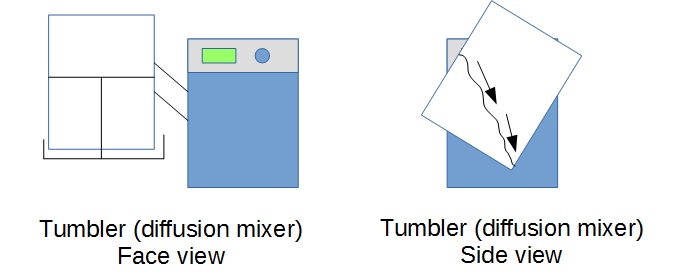
Figure 1: Free Fall Diffusive Mixer avalanche movement.
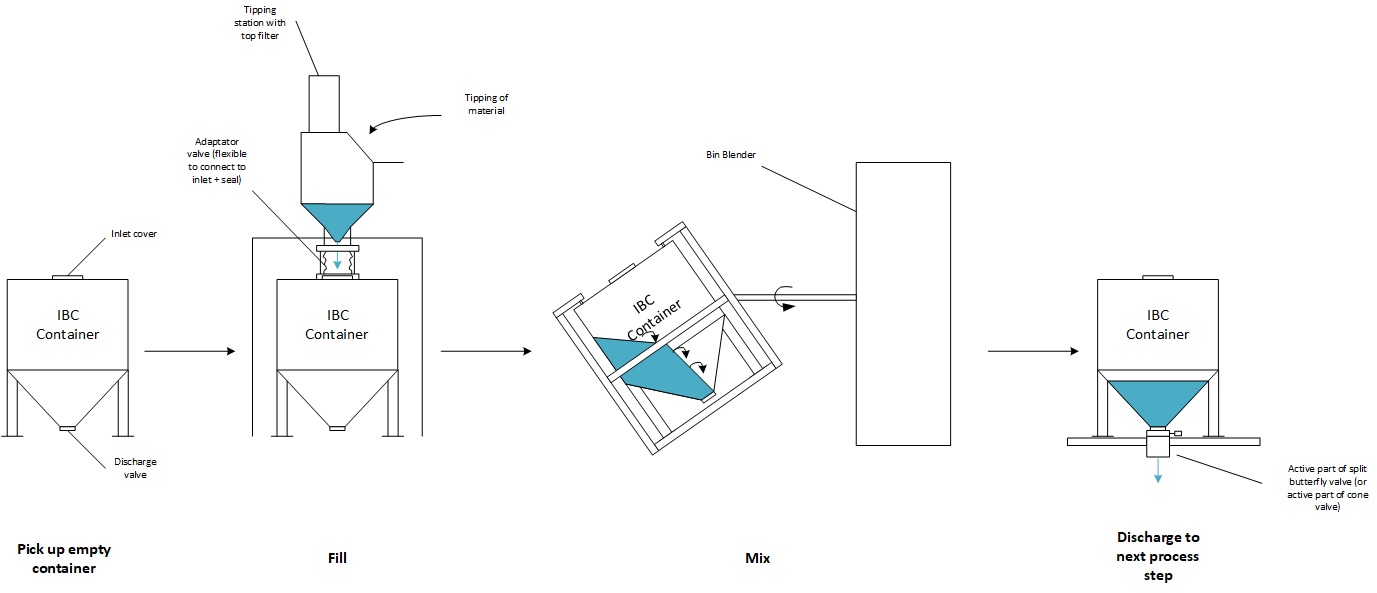
Figure 2: Workflow loop of an IBC Bin Blender process.
Discharge and Docking Valves
To connect the portable bin to charging and discharging points while maintaining high containment (OEB ratings), specific docking mechanisms are deployed:
- Cone Valves: An internal vertically lifting cone lifts inside the hopper to break bridges and fluidize cohesive powders, offering highly controlled discharge.
- Split Butterfly Valves: Composed of an active half on the process line and a passive half on the container. They dock together hermetically, separating only when fully locked, preventing environmental dust emission.
6. Common problems with bin blenders
Table 1: Common operational issues with bin blenders and correction paths
| Observed Issue | Root Cause | Resolution & Optimization |
|---|---|---|
| Poor homogeneity / Extended mixing time | Fill volume exceeds 65%, preventing bed rotation and avalanche space. | Reduce the batch size to 50-55% working capacity. Adjust rotational speed. |
| Segregation / De-mixing | The material is free-flowing with wide differences in particle density or size. | Limit the total blending revolutions. Introduce an active shear intensifier or pre-treat ingredients. |
| Mechanical bridge forming | Cohesive physical binding at the outlet during discharging. | Upgrade the IBC container to incorporate an active lifting cone valve. |
| Inefficient plant throughput | Excessive cleaning downtime at the blender station. | Switch from fixed vessel systems to multiple independent portable IBC containers. |
References and Sources
Mixing in the Process Industries, Harnby, Edwards, Nienow, Butterworth Heinemann, 1992
Food Mixing: Principles and Applications, Cullen, Wiley-Blackwell, 2009
Perry's Chemical Engineers' Handbook, McGraw Hill, 2008